3D PRINTING MATERIAL
PA-CF 3D Printing in Singapore
Carbon-fibre nylon for Singapore's toughest jobs — engineering-grade strength and heat resistance for parts that can't fail.
Same-day quotes · Most prints ready within 1–2 days · See our work →
Get a Quote in PA-CF →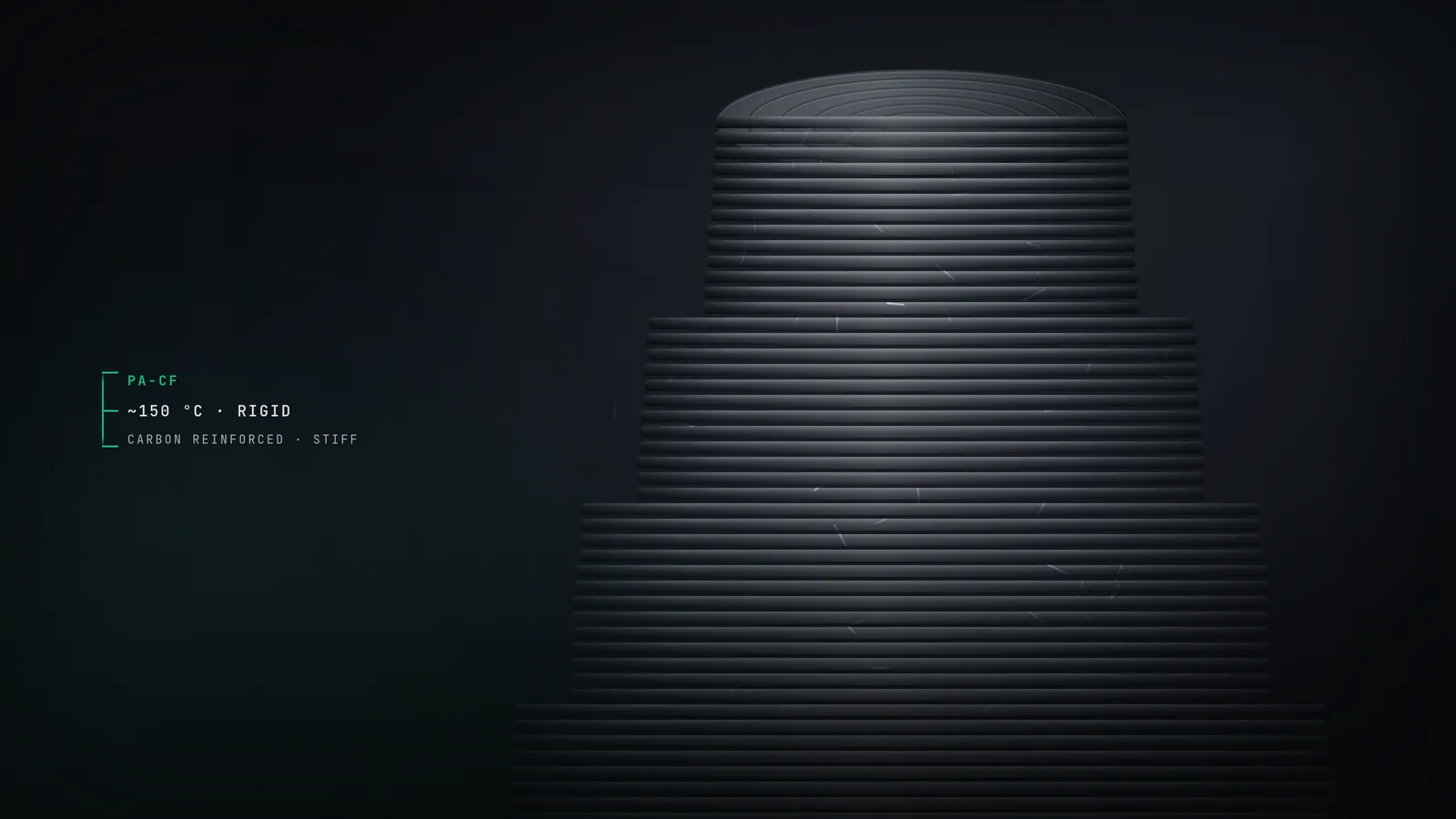
What is PA-CF?
PA-CF is nylon reinforced with chopped carbon fibre — far stiffer and stronger than our standard filaments, with heat resistance well beyond PLA/PETG/ASA. The carbon fibre nearly eliminates warping compared to plain nylon and gives a rigid, matte-black finish. Because it is hygroscopic and its fibres are abrasive, every PA-CF job gets a pre-print drying cycle and a hardened-nozzle swap — billed as a flat handling surcharge rather than folded into the per-gram rate. Best reserved for parts that genuinely need engineering-grade strength or heat resistance; for hotter, damper or chemically harsher jobs, step up to PAHT-CF, PPA-CF or PPS-CF.
PA-CF is carbon-fibre-reinforced nylon — the material we reach for when a part genuinely needs to survive real mechanical load or heat, not just look good. Chopped carbon fibre stiffens the nylon matrix, cutting warping dramatically versus plain nylon while pushing heat resistance past 150°C. We print it for drone frames, machining jigs, replacement gears, and brackets that take real force. It's only available in matte black and costs more than our standard filaments, though it's the most affordable of our carbon-fibre options — reserve it for parts where PETG or plain nylon genuinely isn't strong or stiff enough.
Best uses
- ▸Load-bearing brackets & mounts
- ▸Drone and RC structural frames
- ▸Jigs and fixtures for machining
- ▸Replacement gears under real load
- ▸Tooling that must hold tight tolerances
- ▸High-temp housings and enclosures
Pros
- ✓ Much stiffer and stronger than standard filaments
- ✓ Excellent heat resistance (~150 °C)
- ✓ Minimal warping versus plain nylon
- ✓ Dimensionally stable under load
- ✓ Premium matte-black engineering finish
- ✓ Good chemical resistance
Cons
- ✗ Highly hygroscopic — must be dried before every print
- ✗ Abrasive — requires a hardened/wear-resistant nozzle
- ✗ Costs more than standard filaments
- ✗ Matte black finish only, no colour options
- ✗ Poor UV resistance without a coating
- ✗ Advanced difficulty — warps without a tuned profile
Key properties
Which carbon-fibre material is right for you?
All four are reinforced with chopped carbon fibre, print in matte black and carry a flat handling fee for drying and a hardened nozzle. Start with PA-CF and step up only when the part's heat, humidity or chemical exposure calls for it. If the part stays under about 100 °C and isn't load-critical, PETG, ASA or PC will be cheaper and faster.
PA-CF
This pageThe default carbon-fibre choice.
Choose it when the part carries real load, needs to be stiff and light, and stays below about 150 °C in a normal indoor environment. It is the most affordable of the four.
Look elsewhere if it sits somewhere hot and damp for long periods, or near oils and fuels.
PAHT-CF
For parts that run hot or live somewhere humid.
Choose it when the part sits in a car, beside a motor or in a warm enclosure (up to about 180 °C), or press-fits and bolt holes must hold their size in Singapore’s humidity.
Look elsewhere if it sees sustained heat above about 180 °C or harsh chemicals.
About PAHT-CF →PPA-CF
Maximum stiffness, a stand-in for machined metal.
Choose it when you are replacing an aluminium part, the part must not flex or creep under load, it runs above 200 °C, or it is splashed with oil, fuel or coolant.
Look elsewhere if it has snap-fits, clips or living hinges, or the budget matters more than the last bit of stiffness.
About PPA-CF →PPS-CF
Extreme heat, chemicals and flame resistance.
Choose it when the part is exposed to solvents, acids or fuels, needs to be flame retardant (battery and electrical enclosures), or sits next to an oven or heater (up to about 260 °C).
Look elsewhere if it takes knocks or has to flex at all. It is stiff but brittle, so keep it to static parts.
About PPS-CF →| Compared | PA-CF | PAHT-CF | PPA-CF | PPS-CF |
|---|---|---|---|---|
| Max working temp | ~150 °C | ~180 °C | ~220 °C | ~260 °C |
| Stiffness | High | High | Highest | High |
| Impact toughness | Good | Good | Fair | Low (brittle) |
| Humidity stability | Fair | Good | Good | Excellent |
| Chemical resistance | Good | Good | Excellent | Best |
| Flame retardant | No | No | No | Yes |
| Relative price | $ | $$ | $$$ | $$$$ |
Not sure? Tell us what the part does, how hot it gets and what it touches, and we'll recommend one.
From our workshop
PA-CF is hygroscopic and its chopped-fibre content is abrasive, so every PA-CF job gets a pre-print drying cycle plus a hardened-nozzle swap before we run it — billed as a flat handling fee on top of the per-gram rate, shown separately on your quote. Because of Singapore's humidity we dry every spool fresh rather than trusting shelf life. Turnaround may run a little longer than PLA/PETG jobs; if your part doesn't need PA-CF's strength or heat resistance, plain PETG or ASA will usually be cheaper and faster.
Guides on printing with PA-CF
Ready to print in PA-CF?
Upload your STL or 3MF file and get an instant quote in seconds.