Materials Guide
COMPARE MATERIALS
Choose up to 3 materials to compare side by side. Every material has unique strengths — pick the right one for your project's requirements.
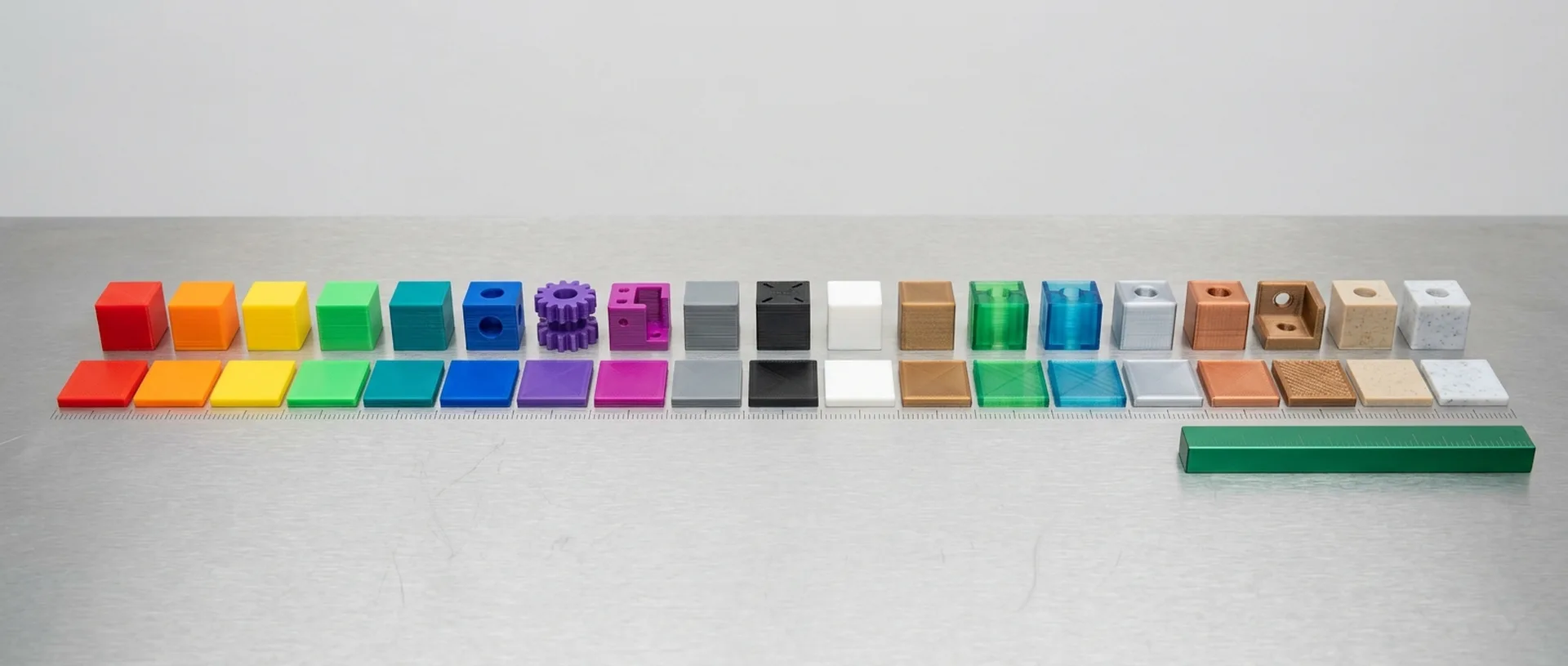
Click to select/deselect. Maximum 3 materials.
Not sure?
WHICH MATERIAL SHOULD I CHOOSE?
Answer a few questions and we'll recommend the best material. Or use the common scenarios below. Prefer a written deep-dive? Read PLA vs PETG compared or choosing materials that survive outdoors.
Question 1 of 4
0%
What will you use the part for?
Common Scenarios
Prototyping & Concept Models
Recommended: PLAFast, cheap, excellent detail. Perfect for validating designs before committing to stronger materials.
Quote with PLA →Outdoor & Weather-Exposed Parts
Recommended: ASAUV-stable and weather resistant. Maintains colour and strength through sun, rain, and humidity.
Quote with ASA →Mechanical & Load-Bearing Parts
Recommended: NylonExceptional toughness and fatigue resistance. Self-lubricating for gears and moving parts.
Quote with Nylon →Flexible Gaskets & Seals
Recommended: TPURubber-like flexibility with excellent abrasion resistance. Can be bent and stretched repeatedly.
Quote with TPU →Food-Contact Containers
Recommended: PETGFood-safe grades available with good chemical resistance. Stronger than PLA.
Quote with PETG →High-Temperature Applications
Recommended: PCWithstands up to 120 °C. Engineering-grade strength for demanding environments.
Quote with PC →Hot & Humid Engineering Parts
Recommended: PAHT-CFCarbon-fibre nylon that holds its shape to ~180 °C and absorbs less moisture. Built for engine bays and motor housings.
Quote with PAHT-CF →Metal-Replacement & Stiff Structural Parts
Recommended: PPA-CFOur stiffest material, strong past 200 °C and resistant to oils and fuels. A candidate to replace machined aluminium.
Quote with PPA-CF →Chemical, Electrical & Flame-Sensitive Parts
Recommended: PPS-CFHighest heat and chemical resistance we print, and inherently flame retardant. For static parts, not clips.
Quote with PPS-CF →Engineering materials
WHICH CARBON FIBRE?
All four are reinforced with chopped carbon fibre, print in matte black and carry a flat handling fee for drying and a hardened nozzle. Start with PA-CF and step up only when the part's heat, humidity or chemical exposure calls for it. If the part stays under about 100 °C and isn't load-critical, PETG, ASA or PC will be cheaper and faster.
PA-CF
The default carbon-fibre choice.
Choose it when the part carries real load, needs to be stiff and light, and stays below about 150 °C in a normal indoor environment. It is the most affordable of the four.
Look elsewhere if it sits somewhere hot and damp for long periods, or near oils and fuels.
About PA-CF →PAHT-CF
For parts that run hot or live somewhere humid.
Choose it when the part sits in a car, beside a motor or in a warm enclosure (up to about 180 °C), or press-fits and bolt holes must hold their size in Singapore’s humidity.
Look elsewhere if it sees sustained heat above about 180 °C or harsh chemicals.
About PAHT-CF →PPA-CF
Maximum stiffness, a stand-in for machined metal.
Choose it when you are replacing an aluminium part, the part must not flex or creep under load, it runs above 200 °C, or it is splashed with oil, fuel or coolant.
Look elsewhere if it has snap-fits, clips or living hinges, or the budget matters more than the last bit of stiffness.
About PPA-CF →PPS-CF
Extreme heat, chemicals and flame resistance.
Choose it when the part is exposed to solvents, acids or fuels, needs to be flame retardant (battery and electrical enclosures), or sits next to an oven or heater (up to about 260 °C).
Look elsewhere if it takes knocks or has to flex at all. It is stiff but brittle, so keep it to static parts.
About PPS-CF →| Compared | PA-CF | PAHT-CF | PPA-CF | PPS-CF |
|---|---|---|---|---|
| Max working temp | ~150 °C | ~180 °C | ~220 °C | ~260 °C |
| Stiffness | High | High | Highest | High |
| Impact toughness | Good | Good | Fair | Low (brittle) |
| Humidity stability | Fair | Good | Good | Excellent |
| Chemical resistance | Good | Good | Excellent | Best |
| Flame retardant | No | No | No | Yes |
| Relative price | $ | $$ | $$$ | $$$$ |
Not sure? Tell us what the part does, how hot it gets and what it touches, and we'll recommend one.
Print Quality
LAYER HEIGHT & SURFACE FINISH
Layer height determines the trade-off between surface smoothness and print speed. We'll recommend the best option based on your part requirements.
0.12 mm
Fine
Best surface finish. Near-invisible layers. Ideal for display models and detailed parts.
Best with: PLA, PETG
0.20 mm
Standard
Good balance of quality and speed. Suitable for most functional and visual parts.
Best with: All materials
0.28 mm
Draft
Visible layers but significantly faster. Good for internal parts, jigs, and rough prototypes.
Best with: PLA, PETG, ASA
Material Details
PLA
PLA is the most popular 3D printing material and the ideal starting point for most projects. It is plant-based, biodegradable, and produces excellent surface detail with minimal warping. Best suited for prototypes, display pieces, and parts that will not be exposed to heat or heavy loads.
Typical Uses
Pros
- +Easiest material to print
- +Excellent dimensional accuracy
- +Low warping
- +Biodegradable and low-odour
Cons
- -Brittle under impact
- -Very low heat resistance (~60 °C)
- -Degrades in UV light over time
- -Not suitable for outdoor use
PETG
PETG strikes an excellent balance between strength, flexibility, and ease of printing. It offers superior layer adhesion and impact resistance compared to PLA, along with good chemical and moisture resistance. A versatile all-rounder for functional parts.
Typical Uses
Pros
- +Strong layer adhesion
- +Good impact resistance
- +Chemical and moisture resistant
- +Food-safe grades available
Cons
- -Stringing can be an issue
- -Supports are harder to remove
- -Surface finish slightly glossy
- -Scratches more easily than PLA
All Materials at a Glance
| Material | Strength | Heat Resistance | Flexibility | Ease of Printing | UV Resistance | Chemical Resistance | Food Safe | |
|---|---|---|---|---|---|---|---|---|
| PLA | Yes | Get Quote | ||||||
| PETG | Yes | Get Quote | ||||||
| ASA | No | Get Quote | ||||||
| TPU | No | Get Quote | ||||||
| Nylon | No | Get Quote | ||||||
| PC | No | Get Quote | ||||||
| PA-CF | No | Get Quote | ||||||
| PAHT-CF | No | Get Quote | ||||||
| PPA-CF | No | Get Quote | ||||||
| PPS-CF | No | Get Quote |
Every material is printed on our Bambu Lab H2-series machines. See why we only use the H2 series →
Material FAQs
COMMON MATERIAL QUESTIONS
Still unsure which filament fits your project? Read the full FAQ or get an instant quote →